
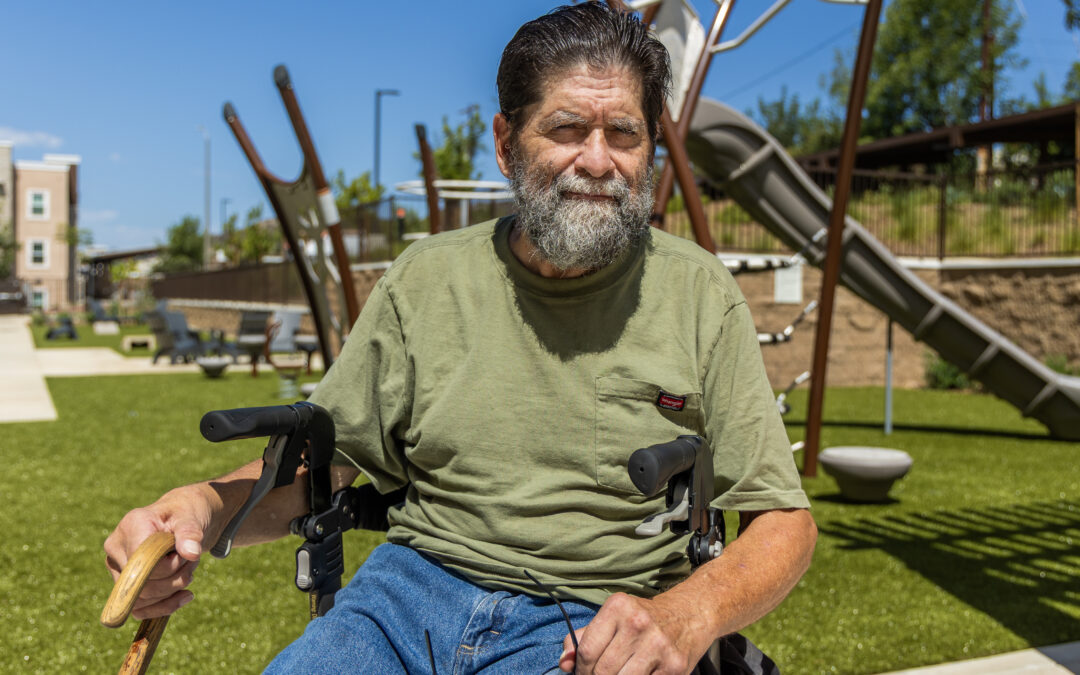
When Robert, 67, looks out from the balcony of his new apartment at Villa Serena II at the calm streets of San Marcos, he says it’s night and day from the places he once called home – apartments infested with roaches and black mold, seedy motels and even his car.
Villa Serena II, the second phase of National CORE’s nearly 30-year effort to transform an aging San Marcos property, opened in August with 63 affordable apartment homes for some of San Diego County’s most vulnerable residents. Robert has lived there for only three weeks, but he said the change has already been transformative.
“I love every minute in my new home,” Robert said. “I’m so happy, it’s unthinkable that I was given this opportunity.”
Robert, originally from Pittsburgh, Pennsylvania, is a Navy veteran who settled in San Diego after he met his wife in the 1980s. Life was good for a while. He and his wife had two children. Robert worked as an electronics technician for business giants such as Raytheon, Qualcomm and Delta Designs.
After the marriage ended, his ex-wife received full custody and moved with the children to Northern California. Robert said the distance contributed to years of estrangement.
“Being estranged from my son and daughter is a sore spot for me,” Robert said. “My heart aches for missing so much time with them.”
Robert’s struggle with housing began in 2019, when a deteriorating physical condition forced him to retire. Back pain left him reliant on a walker or wheelchair because he cannot stand without assistance for more than a minute.
His pension and Social Security payments limited housing options. A studio he shared with a girlfriend in downtown San Diego cost $1,500 a month but was infested with vermin and black mold.
“I would set my food down and the next thing I knew, there would be a roach in my food. Or I would set a glass of water down and within seconds, there would be a roach floating in it,” Robert said. “Management refused to do anything about it, so I refused to pay rent. Eventually, I agreed to leave and I couldn’t afford to rent anywhere else.”
Renters in San Diego need to earn $50.12 per hour – 2.8 times the City of San Diego minimum wage – to afford average rental costs, according to California Housing Partnership. The same study also noted that 129,829 low-income renter households in San Diego lack access to affordable housing.
In early 2026, Robert’s partner left to live in the Philippines. Since he had no means to pay rent on his own, he started living in his Toyota Highlander. While the car was a modest size, Robert had to crowd in with his walker, wheelchair, clothes and possessions.
For nearly half a year, Robert slept in his car. His biggest challenge was the blazing summer heat. To escape the 90+ degree temperatures, he would hunt for shade and run his air conditioner at all hours of the day and night.
Then Robert learned he had been approved for an apartment at Villa Serena.
He was left speechless when he heard his rent would be $771 for a one-bedroom apartment – nearly twice the size of his last apartment at half the price.
“I just remember sitting in my car and being astonished,” Robert said. “I’m a survivor – I do what I can to stay alive, but I won’t lie: if I didn’t have my new apartment, my life would be terrible. It was so uncomfortable to live like that.”
Now that he has his living situation settled, Robert’s biggest goal is to make a meaningful connection with his children, something he now feels ready to pursue thanks to his newfound stability.
“I would absolutely welcome them to my new home. I just wish I had more time with them,” Robert said. “Now that I’m here, I don’t want to focus on the bad from the past. I want to look to the future and see what can be good. I want to move forward.”
Recent Comments